Couple therapy in Italy typically ranges from EUR 70 to EUR 200+ per session in private care, and Therapsy couple therapy starts from EUR 100 per session with a free first assessment call. For most couples, the budgeting question isn't just the session fee. It's the total cost over several months, plus whether language, format, and reimbursement rules change what they pay.
Therapsy is a multilingual psychotherapy service in Italy that connects expats with therapists who speak their native language.
For expat and intercultural couples, price often reflects more than time in the room. A therapist may be helping two partners work across languages, attachment patterns, migration stress, and different family norms around conflict, closeness, and independence. In cross-cultural psychology, that added complexity often changes the kind of support a couple needs, not just the label on the service.
A couple may also find that the cheapest-looking option costs more in practice. Weekly sessions, travel time, missed work, and a weaker language fit can stretch a short intervention into a much longer one. A useful outside overview of therapy session costs explained can help readers compare formats before focusing on one provider.
Couple Therapy Price in Italy at a Glance
How much should a couple expect to pay in Italy?
Private couple therapy in Italy often falls within a fairly wide range. The exact fee matters, but the more useful question is usually this: what will the full course of support cost, and which parts might be eligible for reimbursement?
That shift in perspective helps many expat couples quickly. A session price is like the fare for one train ride. Your real budget depends on the whole journey, how often you travel, and whether part of the route is covered by an employer plan or insurance policy. A lower listed fee can still lead to a higher overall spend if the language fit is weak, the format is impractical, or the process stretches longer than expected.
For intercultural couples, price can also reflect complexity rather than prestige. A therapist may be working across two languages, different ideas about family closeness, and stress linked to relocation, visas, or distance from support networks. In practice, that often changes the kind of structure a couple needs, how quickly misunderstandings can be clarified, and how many sessions feel useful.
Practical rule: Compare the likely total course cost, not only the per-session number.
Therapy style also affects how couples experience value. Structured approaches often focus on recurring interaction cycles and concrete changes between sessions. Longer or more exploratory work may be better suited to couples dealing with betrayal, long-standing mistrust, or cultural conflicts that sit underneath the argument on the surface. If you want a broader outside overview of therapy session costs explained, that can help before you compare one provider with another.
Why does the same service have such different prices?
The phrase couple therapy price groups together very different kinds of care. One therapist may offer brief online sessions aimed at communication repair. Another may provide longer meetings for couples handling migration stress, mixed-language conflict, or neurodivergence-affirming relationship work.
The cost difference often comes from what is included around the session, not only the session itself. Length matters. Specialist training matters. Language matching matters too, especially when one partner can discuss emotions easily in English and the other reaches for nuance in Italian or another native language. If both partners spend half the hour translating themselves, the nominally cheaper option may become expensive over time.
Therapsy offers couple therapy with three concrete features that affect this calculation: human matching by the Clinical Director rather than an algorithm, therapy in 14 languages, and a choice between online and in-person sessions. For expats, that combination can make pricing easier to assess because the question becomes clearer. You are not only comparing fees. You are comparing likely duration, practical fit, and possible coverage.
How Much Does Couple Therapy Cost in Italy and Abroad?
A practical benchmark helps here. In many private markets, couple therapy often sits somewhere between moderate and high specialist healthcare spending, which is why the posted session fee rarely gives the full picture.
For expat couples, the more useful question is usually not, "What does one session cost?" It is, "What will this course of care probably cost us, and are any parts of it eligible for reimbursement, insurance, or workplace support?" A session price is like the price of one train ticket. The budget depends on the whole route, how many stops you need, and whether part of the trip is already covered.
What are the main price ranges to know?
Across countries, private couple therapy commonly costs more in systems where therapy is paid mainly out of pocket and where specialist relational work is concentrated in large cities. Italy often feels less expensive than some English-speaking markets at first glance, but that first glance can mislead people. A lower fee in one city may come with fewer language options, less schedule flexibility, or a weaker fit for intercultural work.
That matters for international couples. If one partner works long hours, one partner needs therapy in a non-Italian language, or both partners are balancing residency stress and family expectations across countries, the total number of sessions and the risk of drop-off can affect final cost more than a small fee difference.
How does Italy compare in practice?
Italy does not have one fixed national rate for private couple therapy. Fees usually change with therapist experience, city, session length, and whether the work requires bilingual or intercultural competence. Compared with some higher-cost private markets abroad, Italy can look more affordable on paper. Compared with public or insurance-heavy systems, it can still feel expensive if a couple expects broad reimbursement and later learns that couple therapy is treated differently from individual psychotherapy.
Here is a simple way to compare options:
| Market and Format | Typical Price Pattern | What usually affects the final cost |
|---|---|---|
| Italy private practice | Mid-range, with higher fees in larger cities or specialist care | Therapist training, multilingual work, session length, location |
| Italy online private care | Sometimes lower than in-person, sometimes similar | Convenience, cancellation risk, therapist language match |
| Therapsy couple therapy | From EUR 100 | Format choice, multilingual care, and the clinical fit discussed at the first assessment call |
| Higher-cost private markets abroad | Often higher than Italy, especially in major urban centers | Out-of-pocket payment, therapist specialization, local demand |
| Insurance-based or employer-supported systems abroad | The couple may pay less directly if eligible support applies | Policy rules, diagnosis requirements, network restrictions, EAP design |
Why should expats compare total course cost, not just the session fee?
A couple may see EUR 90 with one therapist and EUR 120 with another and assume the first option is cheaper. Sometimes it is. Sometimes it is not.
If the lower-fee option creates repeated rescheduling, language strain, or slower progress because the therapist is not used to intercultural dynamics, the total cost can rise over ten or twelve sessions. The higher-fee option may cost less overall if it leads to steadier attendance and clearer work from the start. This is especially common for couples who switch between English, Italian, and another home language when conflict becomes emotional.
Coverage rules also change the calculation. Some couples focus on the invoice amount and only later ask whether sessions are eligible under private insurance, cross-border reimbursement, or an employee assistance programme. That is backwards. Eligibility can matter as much as price.
A good starting point is to compare the likely full path of care with the wider context of therapy costs in Italy across formats and provider types. That gives you a better base for judging whether a lower sticker price is the lower total cost.
What Determines the Price You Will Pay?
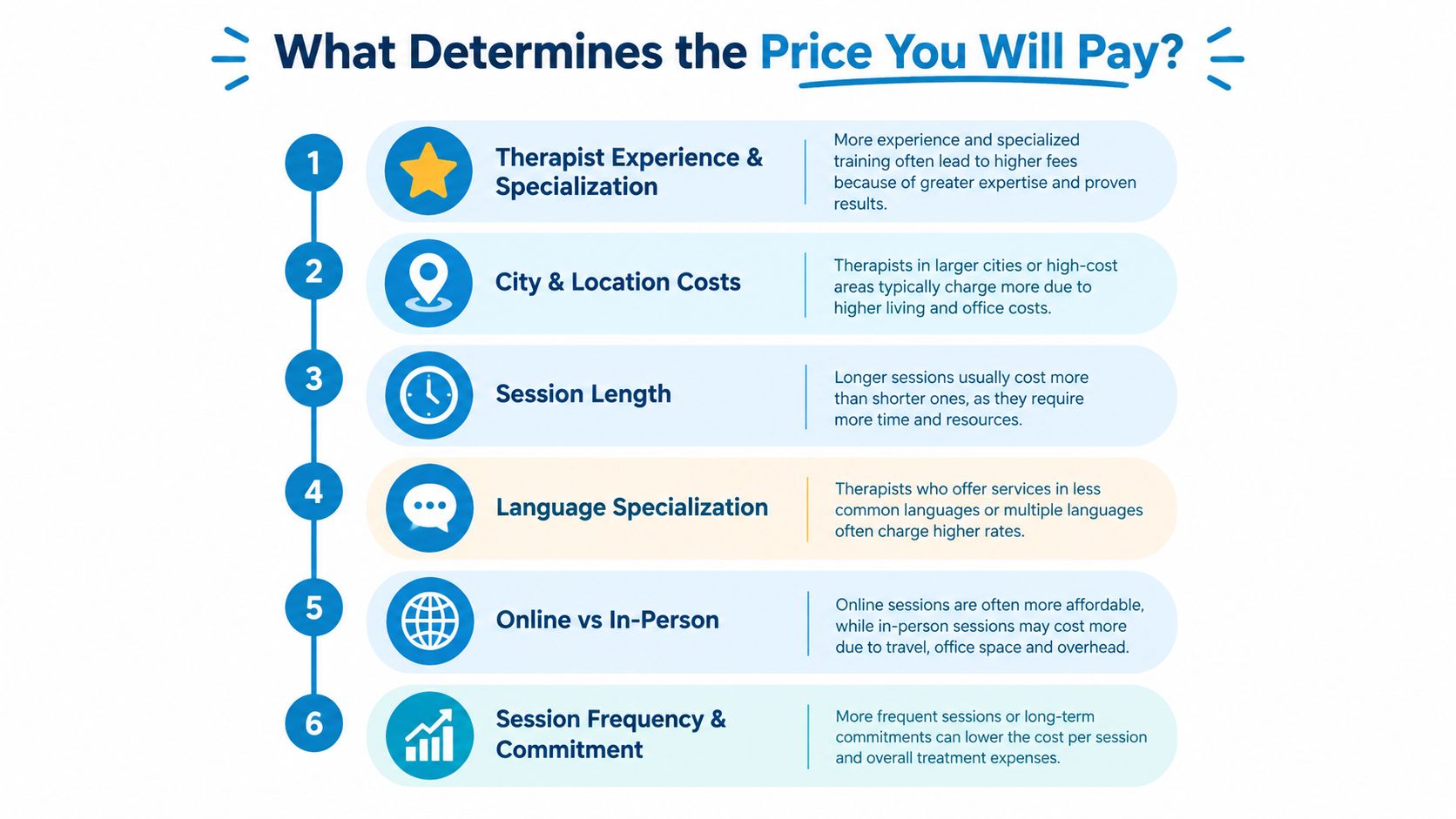
Which factors actually change the fee?
The fee usually changes because the work itself changes. A brief, structured online session for communication repair is different from a longer intercultural session where a therapist is helping a couple untangle trauma responses, migration stress, and family expectations across two cultures.
Does therapist specialization affect couple therapy price?
Yes. Therapists with deeper training in couple work, attachment theory, CBT, EMDR, or Schema Therapy often charge more because the intervention is more specialized. A couple dealing with recurrent conflict after relocation may need more than general supportive conversation. They may need a therapist who can recognize how past relational patterns reactivate under current stress.
Does city or location matter?
Yes, often quite a lot. Large cities usually carry higher operating costs, and demand is often stronger where international workers and students are concentrated. In practical terms, a bilingual therapist in Milan or Rome may price differently from a therapist in a smaller city, even when both are working with similar issues.
A couple isn't only paying for time. They're often paying for access to a therapist with the right language, location, and relational expertise.
Do session length and format change the price?
Yes, because longer sessions allow a different kind of work. Couple sessions often need more time than individual sessions because two nervous systems, two narratives, and the interaction between them are all in the room. A longer format may cost more, but it can also reduce the feeling that sessions end just as the issue becomes clear.
Online versus in-person also affects cost and value differently. Online work can remove travel and make scheduling easier for couples living in different cities or traveling for work. In-person work may feel more grounded for some couples, especially when conflict escalates quickly.
Why does language specialization matter so much for expats?
Language fit changes how precisely people can speak about hurt, fear, criticism, and repair. In cross-cultural couple work, a therapist may need to understand not just vocabulary but different meanings attached to silence, directness, family loyalty, and emotional expression. That extra layer often shapes both the fee and the outcome of the process.
Readers looking specifically for this kind of support often start by reviewing options for an English-speaking couples therapist in Italy. Therapsy focuses on this area through multilingual matching and intercultural clinical framing.
Which Session Format Fits Your Needs and Budget?
Session format shapes cost in the same way a flight itinerary shapes the final ticket price. The seat price matters, but so do stopovers, timing, and whether the route is realistic enough to complete. In couple therapy, the format that usually affects total spending most is the one a couple can maintain long enough for change to happen.
Is a shorter session always the cheaper option?
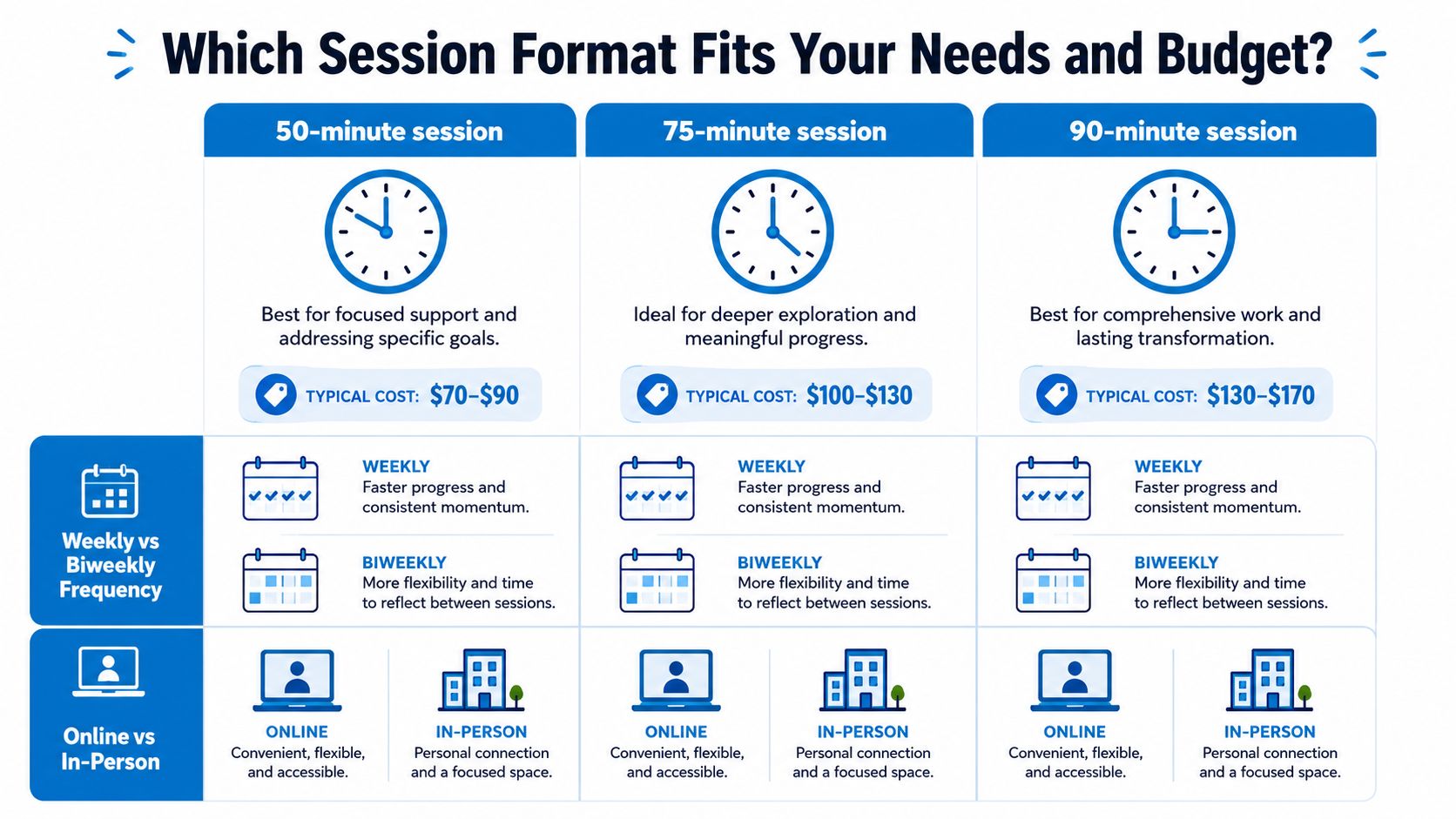
A shorter session often has a lower fee, but lower price per appointment does not always mean lower cost for the whole course of therapy.
Couple work needs enough time for three things: each partner speaks, the therapist tracks the interaction between them, and the session ends with something usable. If the hour ends just when the pattern becomes clear, the couple may need more appointments to reach the same point. For expats, this can happen even faster because part of the session may be spent translating feelings, switching languages, or clarifying cultural meanings.
A simple way to compare formats is to match them to the kind of work being done:
- 50-minute sessions often fit couples with one clearly defined issue and enough stability to stay focused.
- 75-minute sessions often suit couples who need time to slow arguments down and hear both sides without rushing.
- 90-minute sessions can work well when the discussion is layered by relocation stress, blended cultural norms, or histories that need more careful pacing.
The useful question is not only, “What does this session cost?” It is also, “Will this format shorten or stretch the overall process?”
Should sessions be weekly or biweekly?
Frequency changes the total cost through momentum.
Weekly sessions often cost more month to month, but they can reduce drift at the start of therapy. Biweekly sessions may look easier on the budget, yet some couples use much of each meeting to reconstruct what happened since the last one. That can slow progress and extend the number of months in therapy.
This matters for intercultural couples in particular. If partners already differ in conflict style, family expectations, or emotional vocabulary, long gaps between sessions can let the same misunderstandings harden again at home. A schedule that is affordable and steady is usually better than a schedule that looks cheaper but keeps breaking.
How should intercultural couples choose between online and in-person?
Choose the format you can attend consistently, with enough privacy and emotional presence to do honest work.
Online sessions often make sense for expats who travel, live outside major cities, or need a therapist who understands both relationship dynamics and cross-cultural strain. In-person sessions can help when one or both partners regulate better in a shared physical space, or when home does not offer enough privacy for a careful conversation.
The decision is practical before it is ideological. If commuting across Rome, Milan, or another city adds tension, childcare complications, or missed appointments, online may lower the total cost of therapy even if the session fee is similar. If remote sessions lead to distraction, weak engagement, or repeated rescheduling, in-person may be the more efficient option over the full course of care. Couples comparing these options can review whether online couples therapy works before deciding.
Therapsy offers both formats across 21 Italian cities with 80 physical locations, plus online sessions. For many expat couples, that makes the budgeting question clearer. The best-value format is usually the one that fits your language needs, your daily logistics, and the number of sessions you are likely to complete.
Does Insurance or an EAP Cover Couple Therapy in Italy?
Why does coverage depend more on classification than on session price?
For many couples, the largest cost difference does not come from the therapist's fee. It comes from whether the session is eligible for reimbursement at all.
Insurance and EAP systems often sort therapy into categories. Individual treatment linked to a diagnosed mental health condition is usually easier to process. Couple therapy is often placed in a different category, such as relationship support, family work, or non-medical counseling. Once a service falls into that category, reimbursement may shrink or disappear, even if the emotional strain is serious.
A simple way to read this is to treat coverage like a train ticket class. Two people may travel on the same route, with similar timing and a similar destination, but only one ticket type is reimbursable. In therapy, the question is often not “Was this helpful?” It is “How was this coded, and under which partner's benefits can it be claimed?”
That is why the budgeting question is broader than the session fee. Expats usually need to ask about the total course cost after reimbursement, and whether the format they need, such as multilingual private care or sessions involving both partners, is eligible in the first place.
What should expats ask their insurer or EAP provider?
The most useful question is precise: “Do you reimburse sessions attended by both partners, and under what conditions?”
That wording often gets clearer answers than asking whether couples therapy is covered. It helps you find out whether the plan requires one partner to have an individual diagnosis, whether a referral is needed, whether only certain provider types qualify, and whether online, private, or non-Italian-language sessions are excluded.
A practical starting point is this My Policy Quote insurance guide, which outlines the kinds of administrative questions couples should ask before booking.
Why can this be more confusing in Italy for international couples?
Italy adds an extra layer for expats because the care path and the reimbursement path are not always the same. The therapist who fits your language, culture, schedule, and relationship style may work in private practice, while your insurer or employer plan may reimburse only under narrower rules.
This happens often with international couples. One partner may be insured through a foreign employer, the other through a local arrangement. One policy may recognize psychotherapy for an individual but not relational sessions for the couple. An EAP may offer a small number of short-term sessions, but only for assessment or brief support, not for a full course of couple work.
So the useful comparison is not only Italy versus another country's sticker price. It is Italy versus your policy's eligibility rules, wherever that policy was issued.
For a more detailed explanation of how private therapy reimbursement works, readers can review this guide to health insurance cover for therapy in Italy.
How should couples use this information when budgeting?
Start with four checks before you calculate cost. Ask whether the service is covered, whose policy it can be billed under, how many sessions are eligible, and what documents are required for reimbursement.
Those answers usually matter more than a small difference in session fee. A couple paying fully out of pocket for six well-matched sessions may spend less overall than a couple who chooses a theoretically covered option that fits poorly, gets interrupted, or stops after an EAP limit is reached.
Therapsy therefore encourages couples to verify eligibility before committing to a therapy plan, especially when they need multilingual care or a format that includes both partners in the room.
How Does Therapsy Price Couple Therapy?
What does Therapsy charge for couple therapy?
Therapsy offers couple therapy from EUR 100 per session, individual therapy from EUR 70, psychodiagnostic assessment from EUR 255 for 3 sessions, and psychiatric consultation from EUR 110. The first assessment call is free, and the final price depends on the therapist's experience and specialization.

What is included in that pricing approach?
Therapsy's model combines three pieces that many expats need at the same time: human matching done by the Clinical Director rather than an algorithm, therapy in the client's own language across 14 languages, and a choice between online and in-person sessions. The first call is free, and it is with the therapist chosen for that person, which helps couples assess fit before committing.
The service includes therapists working in Italian, English (British), English (American), French, Spanish, German, Portuguese, Ukrainian, Russian, Greek, Arabic, Urdu, Hebrew, and Hindi. For mixed-nationality couples, this matters because one shared language isn't always each partner's emotional language.
Why does matching matter for the total cost?
A strong clinical match can affect how quickly a couple moves from repeating the argument to understanding the pattern underneath it. In CBT, Schema Therapy, and attachment-informed work, that pattern is the target. If the therapist can identify it clearly and communicate in a language that both partners trust, the work often becomes more focused.
Therapsy's clinical team has supported 1,500+ clients across 13,000+ sessions since 2023 through a network of 50+ therapists, with care available online and in person in 21 Italian cities with 80 physical locations. The service also reports a Trustpilot 4.8/5 "Excellent" rating, and first contact arrives within 12 hours. Readers comparing options can review Therapsy pricing and its dedicated page for intercultural couples to see how that model fits their situation.
How Can You Plan and Budget for Couple Therapy?
What is the simplest way to budget before starting?
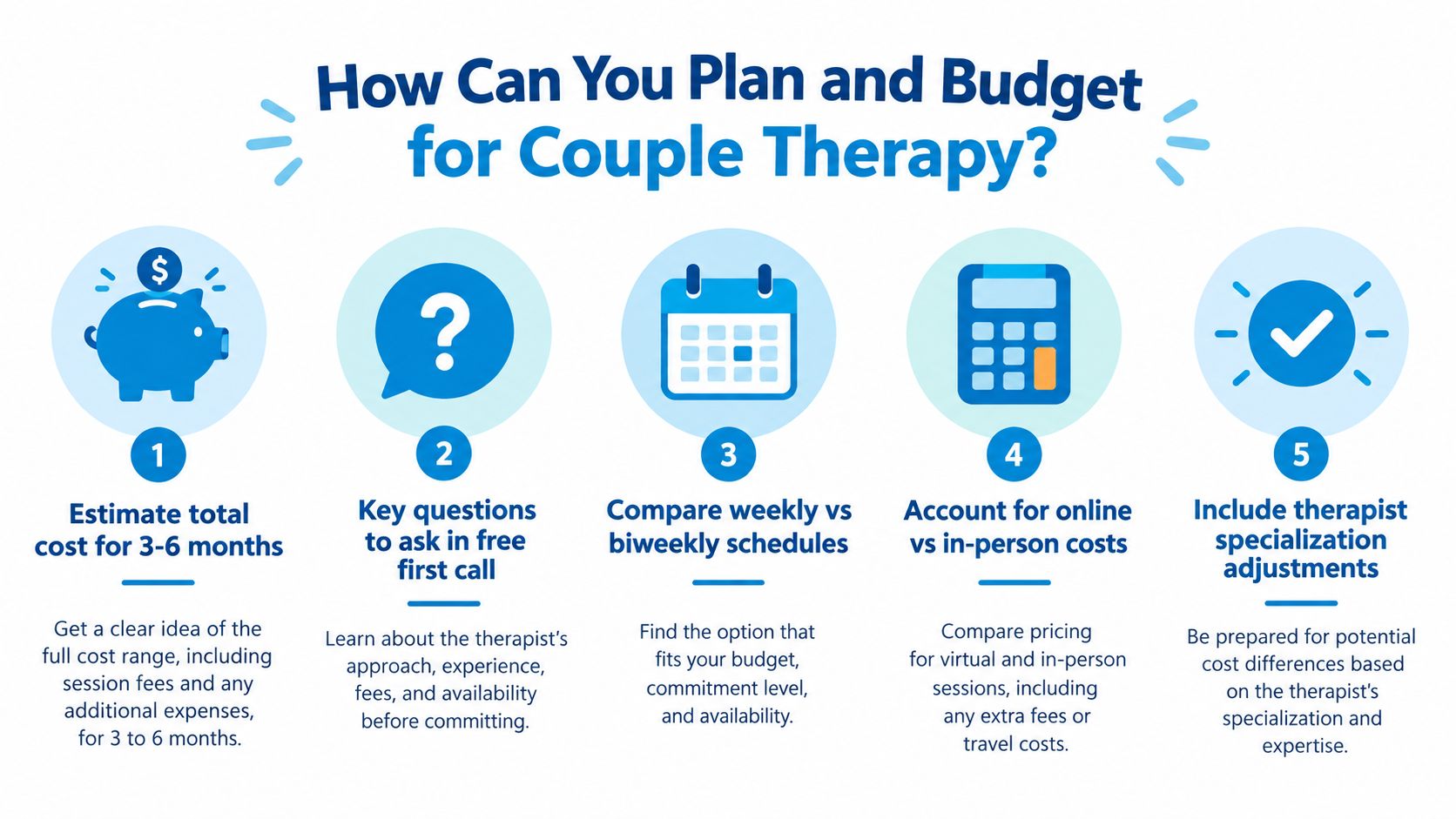
The simplest method is to estimate the full course first and only then compare providers. A couple that budgets for one session at a time often underestimates the commitment, especially when the issue is longstanding or tied to relocation, grief, or repeated conflict.
Which questions help most in the free first call?
A useful first call should clarify process, not sell certainty. Couples often benefit from asking:
- Session rhythm – Is weekly work recommended at the start, or would biweekly sessions still support momentum?
- Language fit – Can both partners speak freely in the proposed session language, especially during conflict?
- Approach – Is the therapist working mainly from CBT, attachment theory, Schema Therapy, EMDR-informed trauma understanding, or a systemic model?
- Practical flexibility – If work travel, exams, or commuting become difficult, can the format shift between online and in person?
How can couples keep costs manageable without choosing blindly?
Lower-cost care can be useful, especially for students and early-career expats, but the goal is fit, not just affordability. Language concordance research in mental healthcare consistently shows that people often communicate more accurately and feel more understood when therapy happens in their strongest language. That doesn't guarantee results, but it can reduce friction and misunderstanding.
Readers exploring budget-sensitive options may also find this guide to low-cost therapy for adults helpful as a practical supplement. In Italy, some people also look for flexible-fee arrangements, and Therapsy offers more information on sliding scale therapy for those starting from a tighter budget.
A well-matched therapist may cost more per session and still cost less overall if the work becomes clearer, steadier, and easier to continue.
What should couples remember before choosing?
The cheapest visible option may not account for transport, missed appointments, or the emotional cost of explaining everything twice because the language fit isn't right. For intercultural couples, a therapist who understands migration, family-of-origin differences, and differing communication norms can make the process more efficient and less draining.
Therapsy supports this planning stage by offering a free first assessment call with the therapist selected for that couple. That makes it easier to ask practical questions before deciding whether to continue.
Frequently Asked Questions About Couple Therapy Price
How long do couples usually stay in therapy?
The length depends on the goal, the level of conflict, and how much external stress the couple is carrying. Some couples come for a focused piece of work, such as rebuilding communication after a move or recurring arguments about roles. Others need a longer process because attachment injuries, trauma history, or intercultural tension keeps reappearing in different forms.
Do both partners need to attend every session?
Not always. Many couple therapists mainly work with both partners together, but there are cases where one or two individual meetings support the broader process. That usually happens to understand each person's history, emotional triggers, or barriers to communication without changing the focus away from the relationship itself.
Is online or in-person therapy better for cost and fit?
Neither format is automatically better. Online therapy can save travel time and widen access to the right language match, which matters for expats outside major cities. In-person therapy may suit couples who regulate better when they share the same physical space with the therapist, especially if conflict escalates quickly.
What happens in the free assessment call?
The free assessment call is usually a fit conversation, not a full therapy session. The therapist clarifies the couple's main concern, listens for practical factors such as language and scheduling, and helps the couple understand whether the approach and format make sense. At Therapsy, that first free call is with the therapist chosen for that person, and there is no obligation to continue.
Therapsy offers couple therapy from EUR 100 per session, with human matching by the Clinical Director, support in 14 languages, and the choice between online and in-person sessions across Italy. For expats and intercultural couples who want to understand both cost and fit before deciding, the first call is free, it is with the therapist chosen for them, and there is no obligation to continue. Readers can explore the next step at THERAPSY.