Does online couples therapy work in the same way as meeting a therapist in a room, or does the screen change the relationship process itself? Online couples therapy can work, especially when it uses a structured protocol, a qualified therapist, active participation, and a private setting. Research has found outcomes comparable to in-person couples therapy, but online care can shape therapeutic alliance, safety assessment, and emotional regulation differently.
Therapsy is a multilingual psychotherapy service in Italy that connects expats with therapists who speak their native language.
What Online Couples Therapy Actually Means
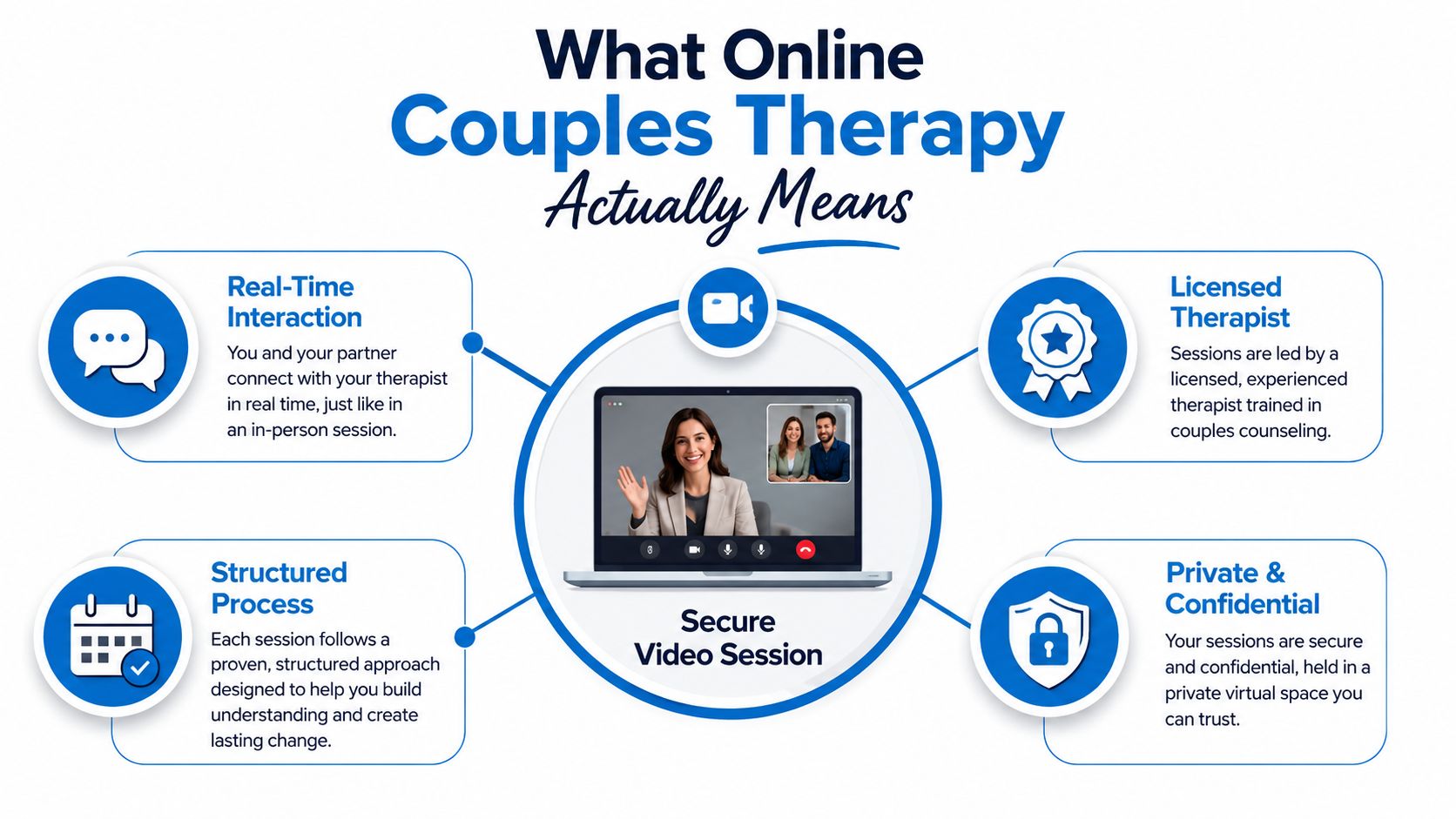
Online couples therapy is real-time psychotherapy delivered through a secure video session with both partners and a trained therapist. It isn't the same as a self-guided relationship app, a recorded couples course, or text-based emotional support. The therapist assesses the relationship, identifies recurring patterns, guides difficult conversations, and helps both partners practise new ways of responding.
A typical session still has a clinical structure. The therapist may begin by checking what happened since the previous meeting, identify a conflict that needs attention, slow down an escalating exchange, and help each partner express the emotion or need underneath the argument. The screen changes the delivery channel, not the core therapeutic task.
The central question isn't whether the therapist is sitting in the same room. It's whether the couple can engage honestly and whether the therapist can provide skilled, structured guidance.
Online sessions can be particularly practical for expat couples in Italy. One partner may travel for work, the couple may live in different countries temporarily, or both partners may struggle to find a therapist who understands their languages and family cultures in the same city. Online care can preserve continuity during relocation, holidays, or periods of frequent travel.
What happens during a session
The therapist usually needs to see and hear both partners clearly. Partners may attend from the same home or from separate private locations, depending on travel, distance, or safety needs.
The work might include:
- Mapping the conflict cycle: identifying how one partner pursues contact while the other withdraws, defends, or shuts down.
- Improving communication: using principles from CBT or systemic-relational therapy to examine thoughts, emotions, behaviours, and family patterns.
- Exploring attachment needs: understanding how fear of abandonment, rejection, or loss of autonomy affects the couple's reactions.
- Working across cultures: making space for differences in directness, emotional expression, gender expectations, family involvement, and ideas about commitment.
- Practising repair: learning how to pause, return to a difficult topic, and respond without repeating the familiar escalation.
Therapsy offers online psychotherapy in Italy and can be relevant when language, distance, or limited local access makes regular in-person appointments difficult. Online delivery isn't automatically a lesser option. It is a different setting that requires thoughtful preparation and a therapist who can manage the relationship process through video.
What the Research Actually Shows
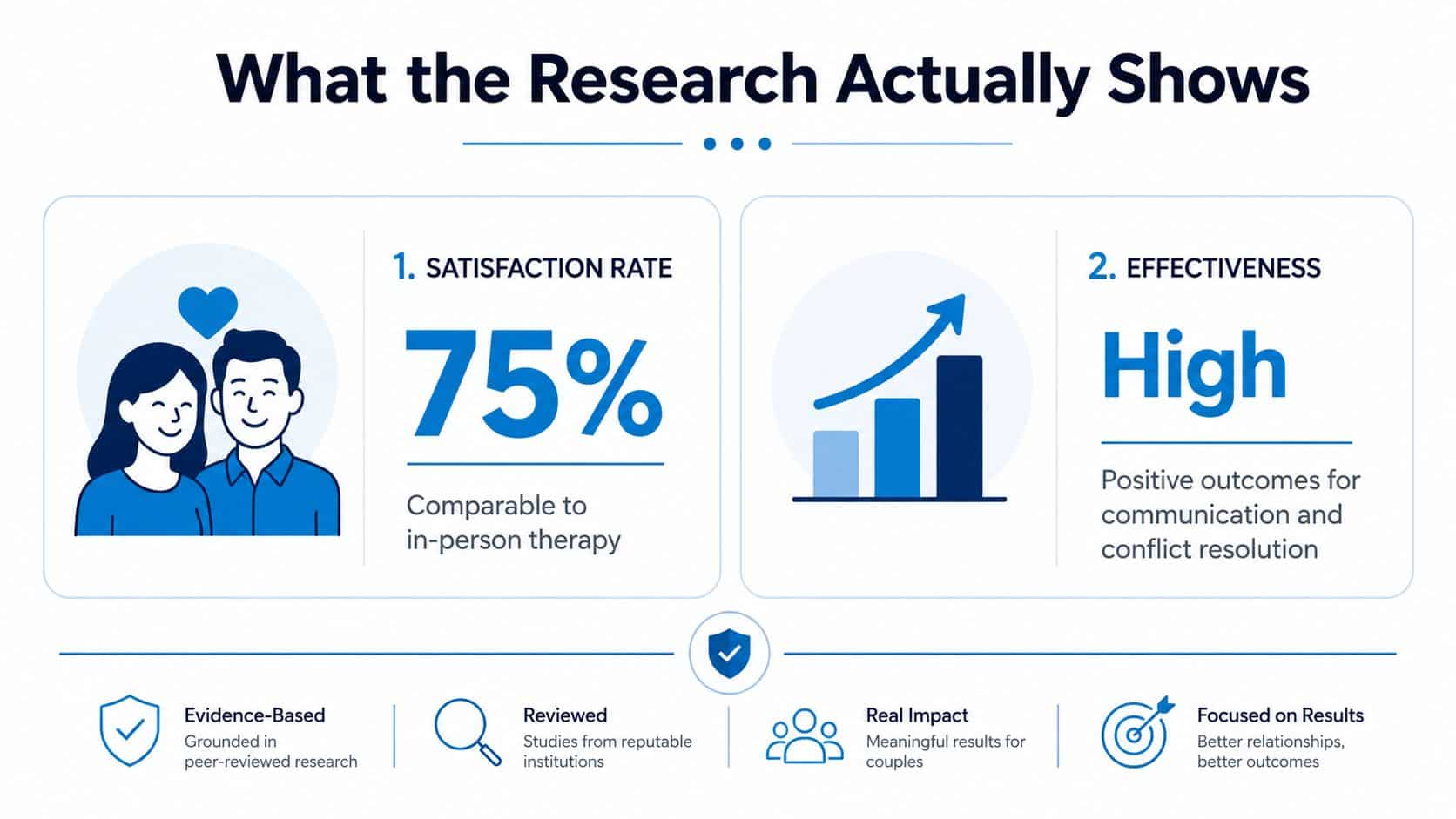
Does online couples therapy work as well as meeting in a room? Comparative research offers a more useful answer than a simple yes or no. In a randomized study of videoconference couples therapy using a structured protocol, researchers found no significant differences between online and in-person groups in relationship adjustment, relationship happiness, therapeutic alliance, satisfaction, or mental-health outcomes. Both groups improved over time in relationship satisfaction and symptoms such as depression, anxiety, and stress. The full findings appear in the randomized study of videoconference couples therapy.
For couples living between Italy and another country, this distinction matters. The format changes the setting and the way connection develops, while the intervention's structure and the couple's participation remain central. A therapist who can maintain focus, respond to both partners, and build trust through video may provide effective care online. Comparing online vs in-person therapy in Italy can help couples choose according to privacy, safety, travel, and the kind of support they need.
A 2025 systematic review and meta-analysis of online relationship interventions found significant improvements in relationship satisfaction across most eligible studies, with a pooled moderate effect size of Hedges' g = 0.42, p <.001. The same source discusses a separate meta-analysis of traditional couple therapy, which reported a larger within-group gain in relationship satisfaction, Hedges' g = 1.12, along with improvements in communication, intimacy, and partner behaviours. The comparison suggests that online interventions can help, although results may depend more strongly on the context, structure, and level of support. See the 2025 review of digital relationship interventions.
What comparative effectiveness means
A separate study of teletherapy and in-person couple therapy included 1,157 married clients. Teletherapy was overall as effective as in-person therapy for improving couple satisfaction, sexual satisfaction, and therapeutic alliance. The process differed, however. Alliance improved at twice the rate in in-person therapy as in teletherapy, suggesting that online care may reach similar outcomes while trust and connection develop differently. The comparative effectiveness study of teletherapy and in-person therapy examines this distinction.
Structured web-based interventions show a similar pattern. The online OurRelationship program is an eight-hour intervention adapted from empirically supported in-person couple therapy. In a nationally representative sample, it improved relationship functioning compared with a wait-list control group, as well as depression, anxiety, work functioning, and perceived health. The OurRelationship intervention research provides further detail.
The evidence still has limits. A 2024 review of online relationship interventions found signs of reduced relationship aggression, but the estimate came from only three studies with substantial variation in effect sizes. Online couples therapy should therefore be selected according to the couple's circumstances, particularly where aggression, coercive dynamics, severe distress, or a need for rapid alliance-building is present. The review of online relationship interventions supports this suitability-based approach.
Benefits and Limitations of the Online Format
Online couples therapy changes the practical conditions around treatment. For expat couples, that can be decisive. A couple in Milan may find a therapist who understands intercultural relationships without travelling across the city, while a couple temporarily separated between Italy and another country may attend the same session from different locations.
The main advantages include:
- Continuity during relocation: sessions can continue when one partner moves, travels, or changes work location.
- Language access: couples can search for a therapist who can work in both partners' preferred languages.
- Scheduling flexibility: online care can reduce travel time and make regular attendance easier for professionals or parents.
- A familiar environment: some partners speak more openly from a private home than from an unfamiliar office.
- Broader specialist access: couples aren't limited to therapists practising in their immediate neighbourhood.
What the screen can make harder
A therapist can observe tone, facial expressions, pauses, and body language online, but the picture may be less complete. Small movements can disappear from view, technology can interrupt emotional momentum, and a partner may mute themselves or look away during a vulnerable moment.
Online work may also make rupture repair more demanding. If the couple becomes overwhelmed, the therapist has fewer options to change the physical atmosphere of the room. The couple must create a suitable setting themselves, which means removing notifications, choosing a private space, and agreeing not to leave abruptly unless there is a clear safety reason.
Online therapy works best when the couple treats the home environment as part of the therapeutic setting. Privacy and presence aren't minor details. They support the work.
The format can be useful for anxiety-related relationship strain, but it doesn't remove the need for careful clinical assessment. Couples can explore online therapy for anxiety when worry, panic, or chronic stress affects communication, while still discussing whether joint sessions, individual therapy, or both are appropriate.
For intercultural couples, the therapist's cultural competence may matter more than the physical setting. A screen with the right therapist can be more helpful than an office where one partner feels linguistically misunderstood or culturally judged.
Who Online Couples Therapy Is Best Suited For
Online couples therapy tends to fit couples who can remain physically safe, participate voluntarily, and create enough privacy for difficult conversations. The format is often especially useful when access, distance, or language would otherwise prevent consistent care.
Couples living across countries or cities
One partner might work in Rome while the other remains in Milan, or a couple might be temporarily separated during a visa, study, or employment transition. A shared online appointment can maintain a sense of joint work when ordinary routines are already disrupted. Long-distance relationship therapy can help couples examine insecurity, missed connection, reunion stress, and the practical agreements that distance requires.
Intercultural and bilingual couples
A foreign partner and an Italian partner may disagree about family boundaries, financial responsibility, marriage, parenting, or the role of extended relatives. The argument may appear to be about a specific decision, while the deeper issue concerns belonging, loyalty, or what each person learned relationships should look like.
A multilingual therapist can clarify whether a disagreement reflects different values, different meanings attached to the same words, or a repeating attachment pattern. The therapist should also ask which language allows each partner to express vulnerability most accurately.
Couples with demanding schedules
Professionals, parents, and international students may struggle to attend appointments in the same location. Online sessions can reduce logistical friction, although they still require protected time and genuine attention.
Couples in areas with limited specialist access
A couple outside a major Italian city may not have easy access to a therapist trained in couples work or experienced with intercultural relationships. Online care can widen the practical choice, provided the therapist is appropriately licensed and able to work with the couple's location and needs.
Couples who need a thoughtful intake first
Online therapy may be workable when one partner is hesitant, highly avoidant, or inclined to use physical distance to escape emotional contact. That doesn't make online care automatically unsuitable, but it makes the initial assessment especially important. A therapist should evaluate motivation, privacy, conflict intensity, individual mental-health needs, and whether both partners can participate safely.
Therapsy supports online and in-person couples work across Italy, including multilingual care for international and intercultural couples. The format should follow the couple's clinical needs, not the other way around.
How to Get the Most Out of Online Couples Therapy
The screen won't create change by itself. Couples usually get more from online therapy when they protect the appointment, arrive with a shared intention, and practise what they discuss between sessions.
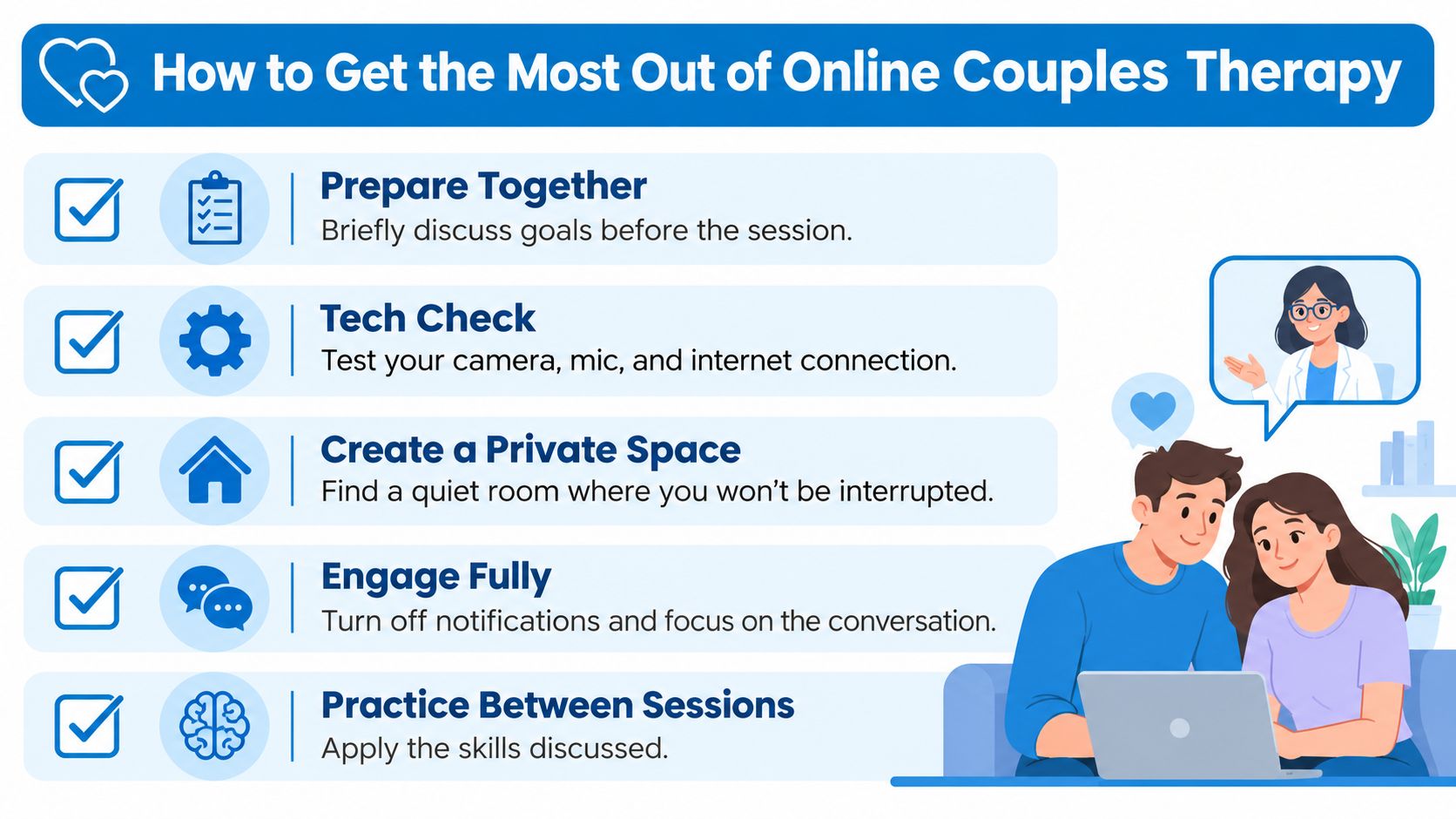
Start with a short pre-session ritual. Before opening the video call, each partner can name one topic they want help with and one thing they hope the therapist understands. This isn't a debate or a rehearsal of accusations. It gives the therapist a clearer starting point.
A practical preparation checklist
- Choose privacy together. Use a room where other people can't overhear the session. If children, flatmates, or relatives are nearby, arrange coverage before the appointment.
- Test the technology. Check the camera, microphone, internet connection, and device battery before the session begins. Keep a phone available only as a backup contact if the call fails.
- Remove competing demands. Close work messages, silence notifications, and avoid attending from a car or public space.
- Sit where both partners can be seen. The therapist needs a clear view of each person's face and, when possible, upper body and posture.
- Avoid alcohol or other substances before the session. Clear attention supports honest communication and emotional regulation.
- Agree on a pause signal. A pause should slow the conversation, not end it permanently. Ask the therapist how to handle breaks before a conflict becomes intense.
During the session, look toward the camera when speaking and toward your partner when listening. Tell the therapist when you feel misunderstood, when the pace is too fast, or when one partner is receiving more attention. Feedback isn't disrespectful. It gives the therapist information about the alliance.
Between sessions, practise one skill rather than attempting to transform every interaction. A couple might use a timed conversation, reflect back what they heard, or postpone a difficult discussion until both partners are regulated. Therapsy's online sessions can be integrated into a wider plan that includes individual support when anxiety, depression, trauma, or burnout is affecting the relationship.
Choosing the Right Online Couples Therapist
The therapist often matters more than the platform. Look for a licensed professional with specific couples-therapy training, experience with the concerns you bring, and the ability to manage two perspectives without taking sides.
Different approaches emphasise different parts of relationship change:
- Emotionally Focused Therapy: explores attachment needs and the emotional cycle that keeps partners stuck.
- Cognitive-Behavioral Couple Therapy: examines how thoughts and behaviours reinforce conflict.
- Systemic-relational therapy: considers family history, roles, cultural context, and patterns between people.
- The Gottman Method: uses structured assessment and skills-based work around communication, friendship, conflict, and shared meaning.
- EMDR-informed work: may be relevant when trauma affects trust, emotional reactions, or intimacy, although the therapist must assess whether joint or individual treatment should come first.
- Schema Therapy: examines deep patterns formed through earlier experiences, such as abandonment, mistrust, or emotional deprivation.
| Criterion | What to look for |
|---|---|
| Professional qualification | A licensed mental-health professional with relevant couples-therapy training |
| Clinical approach | A clear explanation of the model and why it fits your concerns |
| Language | The ability to work in the language or languages in which both partners can be emotionally precise |
| Cultural competence | Familiarity with migration, intercultural identity, family expectations, and life in Italy |
| Safety assessment | Direct questions about coercion, aggression, privacy, and individual mental-health needs |
| First conversation | Space for both partners to assess comfort, neutrality, and fit |
Therapsy uses human matching by the Clinical Director rather than automated questionnaires or chatbots. Its network includes carefully selected licensed professionals, clinical supervision, online and in-person sessions, and therapy in 14 languages, including Italian, English, French, Spanish, German, Portuguese, Ukrainian, Russian, Greek, Arabic, Urdu, Hebrew, Hindi, and Persian (Farsi). Couples seeking an English-speaking couples therapist in Italy can use a free assessment call to discuss language, culture, goals, and fit.
When In-Person or Higher-Intensity Care May Be Better
Online couples therapy isn't the safest starting point for every relationship. A therapist may recommend in-person care, individual stabilisation, or a higher-intensity plan when the couple can't maintain safety or emotional regulation during video sessions.
Consider additional or different support when:
- A partner fears retaliation for speaking openly or ending the session.
- Coercive control or active aggression affects the relationship.
- Conflict escalates rapidly and neither partner can pause without threatening, intimidating, or pursuing the other.
- Substance use makes reliable participation difficult.
- A severe individual condition needs assessment or stabilisation before joint work.
- The couple cannot secure privacy in either home environment.
- The therapist can't adequately assess risk through the available format.
A 2024 review found signs that online relationship interventions may reduce relationship aggression, but the evidence was limited to three studies with substantial variation. That uncertainty matters. Couples dealing with aggression or coercive dynamics need an individualised safety assessment rather than a generic assumption that online care is appropriate.
In-person sessions may offer more immediate co-regulation when both partners are overwhelmed. Some couples may also benefit from intensive blocks, a planned combination of individual and couples therapy, or a temporary shift to in-person work before returning online. The format can change as the relationship becomes safer and more stable.
Therapsy offers both online and in-person sessions across 24 Italian cities and 90+ physical locations, which can support a flexible transition when a therapist believes a different setting would be more suitable. If there is immediate danger, contact local emergency services or a trusted local crisis resource rather than waiting for a therapy appointment.
Final Thoughts and Frequently Asked Questions
Online couples therapy works for many couples, but the video call isn't the active ingredient. Skilled treatment, a strong therapeutic relationship, cultural understanding, privacy, and consistent engagement shape what couples can achieve. For expat and intercultural couples in Italy, online care can make continuity and language access possible, while in-person or higher-intensity support may be safer for severe conflict or relationship danger.
Therapsy provides human-matched online and in-person psychotherapy for international, multilingual, and intercultural couples in Italy. A free first assessment call gives both partners space to discuss their situation before deciding what kind of support fits.
Frequently asked questions about online couples therapy
Does online couples therapy work as well as in-person therapy?
Yes, structured online couples therapy can produce outcomes comparable to in-person therapy for many couples. Research found no significant between-group differences across relationship, satisfaction, alliance, and mental-health outcomes in a randomized videoconference study. The therapeutic alliance may develop differently online, so fit and therapist skill remain important.
Is online couples therapy effective for long-distance couples?
Yes, online couples therapy can be especially practical when partners live in different cities or countries. Both people can attend the same session without coordinating international travel, while the therapist helps address distance, uncertainty, reunion stress, and communication patterns. Therapsy offers online support for long-distance and intercultural relationships.
Can online couples therapy help intercultural couples?
Yes, it can help partners explore language differences, family expectations, migration stress, and conflicting cultural assumptions. The therapist should understand both the relationship dynamics and the cultural meanings attached to them. Therapsy's multilingual network can help couples discuss whether therapy in one language or more than one language would feel most natural.
Is online couples therapy suitable for high-conflict relationships?
It may be suitable for some high-conflict couples, but aggression, coercive control, fear, or serious safety concerns require careful assessment first. A 2024 review found limited and variable evidence regarding reduced relationship aggression in online interventions. Therapsy can help assess whether online, in-person, individual, or combined care is the safer starting point.
What should we do if one partner doesn't want therapy?
Start with an honest conversation about the concern rather than pressuring the reluctant partner. One partner can sometimes begin individual therapy to understand their own responses and consider next steps, while the therapist assesses whether joint work is appropriate. A free assessment call with Therapsy can clarify the process without requiring immediate commitment.
How do language differences affect online couples therapy?
Language differences can affect emotional nuance, conflict interpretation, and each partner's ability to describe vulnerable experiences. A multilingual therapist can slow down translation, check meaning, and distinguish cultural disagreement from relationship injury. Therapsy provides therapy in 14 languages and offers human matching by the Clinical Director.
Can couples therapy happen online if partners are in different countries?
Often, yes, but the therapist must consider privacy, local professional requirements, time zones, and safety in each location. The couple also needs a private environment and a reliable plan if the connection fails. Therapsy can discuss practical arrangements during the initial assessment.
The couples therapists at Therapsy
These clinicians work with couples specifically, online and in person.
Dr. Brandice Harris practises Emotionally Focused Therapy with couples, a structured evidence-based method that works on the emotional bond underneath the argument rather than on who is right about the surface issue. She is in Florence and works online.
Dr. Ivano Calaon has over ten years of practice and is particularly experienced in couples therapy and family counselling, including conflictual separations where children are in the middle. He is in Turin.
Dr. Agathe Scappini works with couples on conflict, communication and how a relationship changes over time, alongside her work on intimacy and sexuality. She offers sessions in French as well as English and Italian.
You do not have to work out who fits on your own. You tell Therapsy what you are looking for, a member of our clinical team reads your request, and they introduce you. The first call is free.
How do we know whether the therapist is right for us?
You should feel that the therapist listens to both partners, explains the treatment approach clearly, and can discuss culture, language, conflict, and safety without taking sides. If the fit feels wrong, raise it early and ask about alternatives. Therapsy's free first assessment call is designed to support a human conversation about matching before therapy begins.
If recurring arguments, distance, cultural differences, or relocation stress are affecting your relationship, Therapsy can connect you with a carefully selected multilingual couples therapist for online or in-person support in Italy. Book a free, no-commitment assessment conversation with the Clinical Director by visiting THERAPSY.